
Is your house still damp days after a leak?
Lingering dampness is the sign that surface drying was not enough. Walls that feel cool, floors that cup, a musty smell and windows that fog all point to moisture still in the structure.
Fans and open windows dry the air in a room, but they rarely pull water out of studs, subfloor and insulation. That takes controlled airflow and dehumidification.
What to look forSigns drying is not finished
Musty or earthy smell
Damp materials give off odor before mold is visible.
Cupping or crowning floors
Wood floors react to moisture trapped beneath them.
Cool, clammy walls
Evaporating water cools the surface.
Condensation on windows
High indoor humidity condenses on cold glass.
How structural drying works
Drying is a physics problem. Water in materials must evaporate into the air, and that wet air must be removed before it condenses somewhere else. The S500 standard is the usual industry reference for this work.
Measure
We record moisture content and humidity to set a baseline.
Place equipment
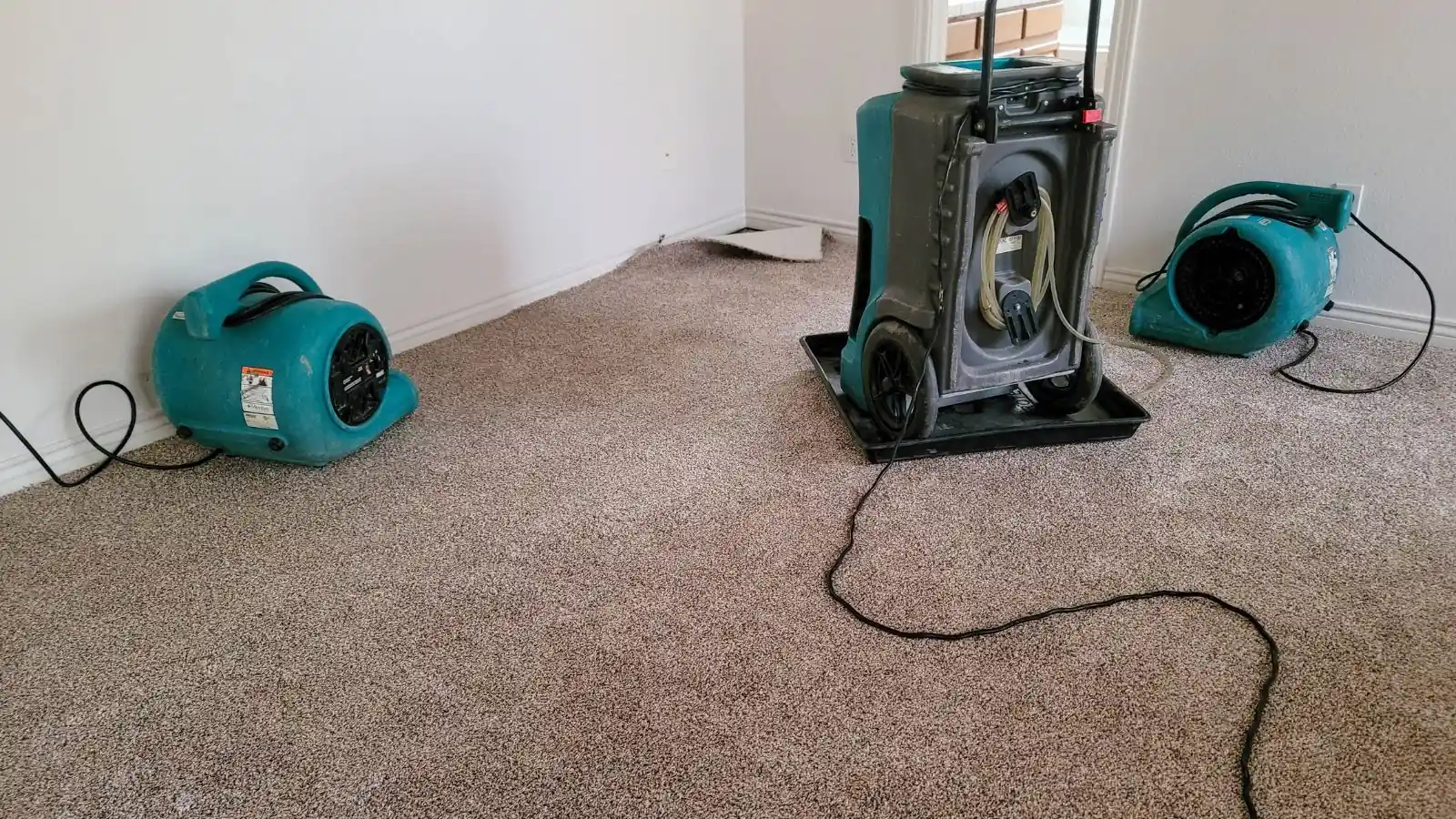
Air movers drive air over wet surfaces, and dehumidifiers pull water out of the air.
Monitor
We return, take readings and move equipment as areas dry.
Confirm
We stop when readings match dry reference points for each material.
Which equipment dries what
| Equipment | What it does | Best for |
|---|---|---|
| Air mover | Moves air across surfaces to speed evaporation | Floors, carpet, wall bases. |
| Refrigerant dehumidifier | Condenses water from warm humid air | Typical house conditions. |
| Desiccant dehumidifier | Absorbs moisture even in cool air | Cold basements, crawl spaces. |
| Injection drying system | Pushes air into wall or floor cavities | Enclosed cavities and under floors. |
Still damp after cleanup?
Call for a moisture check. A dry-looking wall can still be wet inside.
How long drying takes
Most residential jobs need several days of equipment, but the number depends on materials and conditions. Dense hardwood and plaster dry slowly, while carpet dries fast once the pad is removed.
We do not set an end date on day one. We stop when the readings tell us to, and we give you the log.
Cost factorsWhat affects drying cost
Area and volume
More cubic feet mean more equipment.
Materials
Plaster, hardwood and thick framing hold moisture longer.
Days of equipment
Readings decide how many days are needed.
Humidity and weather
Humid summer weather slows drying.
Access
Cavities may need to be opened to dry properly.
We explain scope and price before work starts.
Insurance basicsInsurance and drying
Drying after a covered water loss is usually part of the claim, and moisture logs help show that the work was needed and completed. Ask your carrier what documentation it wants.
Policies differ, so check coverage and any limits on mold. Keep your drying log with your claim papers.
Local conditionsDrying houses in Haverford Township
Houses in Llanerch, Brookline and Beechwood date from the early 1900s, and thick masonry and old framing can hold moisture longer than newer construction. Humid summers in southeastern Pennsylvania slow drying, and closed-up basements dry slowly without active dehumidification.
Drying usually follows water extraction and flood cleanup. If drying was delayed, read about mold remediation. We also serve Wynnewood.
VerificationReading a drying log
The log lists moisture readings by room and date, along with the equipment used. Readings should fall each day. If they stop falling, the crew changes the setup or opens a cavity.
Ask for the log at the end of the job. It shows that drying was verified, not assumed.
LimitsWhen drying is not enough
Some materials do not recover. Saturated insulation, swollen particleboard and drywall that crumbles are cheaper to replace than to dry. Mold growth also changes the scope.
A good crew tells you which category your materials fall into after reading the meters, not before.
Before the crew arrivesWhat to do while equipment runs
Our drying follows the S500 standard as a procedural reference.
Help the equipment work.
- Keep doors to the room closed.
- Do not turn equipment off to save noise.
- Keep the thermostat at a normal setting.
Structural drying questions
Why does my house still smell musty after the water is gone?
Moisture is likely still in the wall cavities, subfloor or insulation. A moisture check can find where.
How do I know the house is dry?
Readings in each material fall to the dry reference. We log them and share the results.
Can I run my own fans and dehumidifier?
For minor dampness yes. For wet structure, rental gear usually does not dry the cavities.
Is the noise constant?
Equipment runs around the clock during drying, and we can place it to reduce the disruption.