
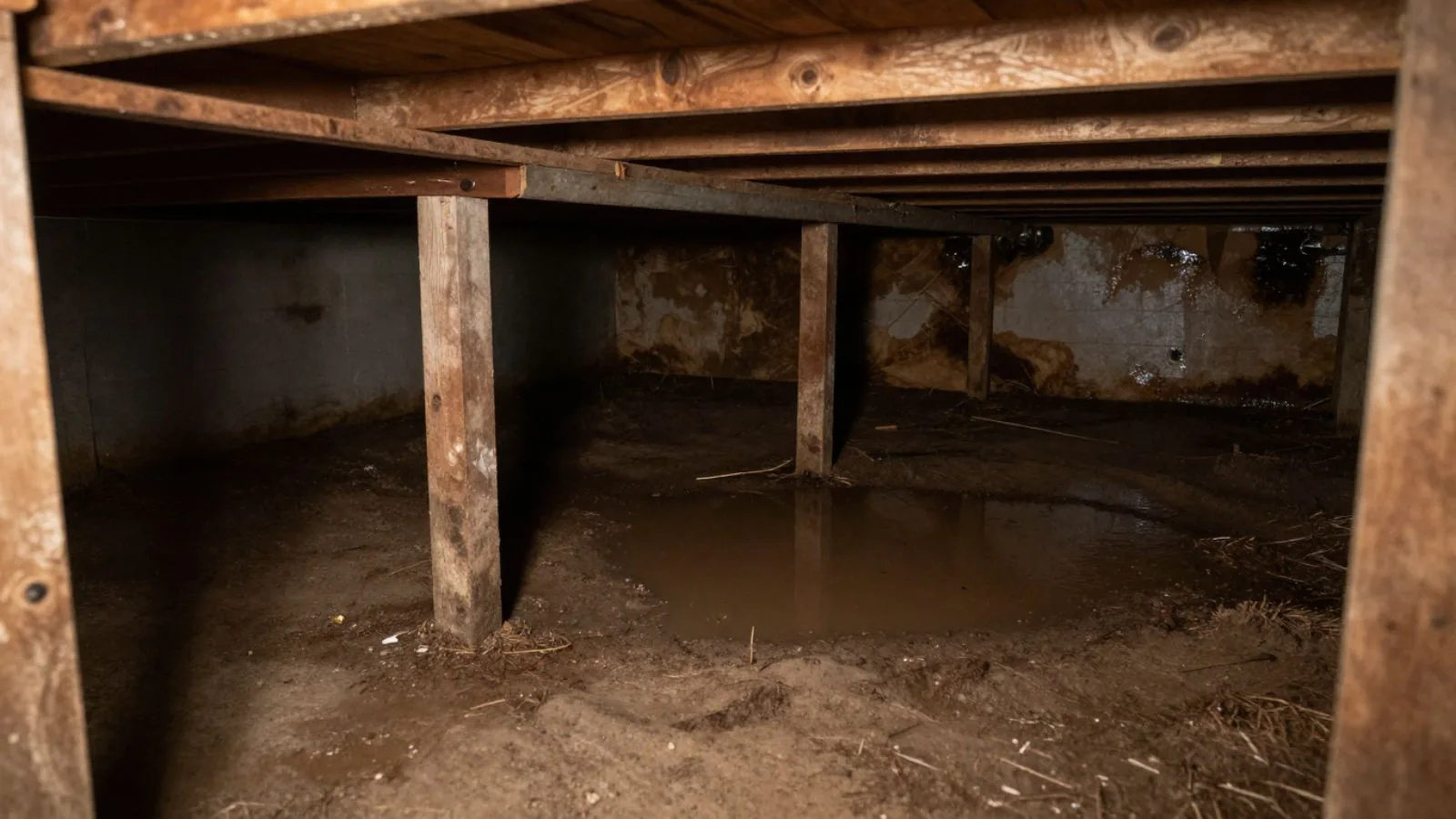
What a wet crawl space does to a house
A crawl space sits directly below the floor, so moisture there moves up through the subfloor and into rooms. Joists and subfloor absorb it, insulation sags and mold can start on damp wood.
You often cannot see the damage from above. A cool floor, a musty smell or a bouncy spot is often the first clue.
What to look forSigns of crawl space moisture
Musty smell in rooms above
Air from below rises into living areas.
Sagging insulation
Wet insulation loses grip and falls.
Standing water or dark soil
Water is entering or collecting.
Cupping floors above
Wood reacts to moisture from below.
Crawl space cleanup, step by step
Inspect
We check access, wiring, ducts and any sump before entering.
Remove water
Small pumps clear standing water, and we remove wet insulation.
Dry the space
Dehumidifiers and air movers run, often with a desiccant unit for cool air.
Document
Moisture readings on joists and subfloor show when the space is dry.
Crawl space options after drying
| Measure | What it does | Consideration |
|---|---|---|
| Vapor barrier on the ground | Limits moisture rising from soil | Must be sealed at seams and walls. |
| Sump or drain | Moves water out | Needs a discharge path. |
| Dehumidifier | Controls humidity | Needs power and maintenance. |
| Grading and gutters | Keeps water away from the foundation | Fixes the cause outside. |
These are the contractor's work. We dry the space and advise on what the readings show.
Water under the house?
Call and keep out of the crawl space until we confirm it is safe.
What affects crawl space cleanup costs
Access
Tight openings slow every task.
Water depth
More water takes longer to pump.
Insulation
Wet insulation must be removed and replaced.
Drying duration
Cool air slows drying, so desiccants run longer.
Mold
If growth is found, remediation is a separate scope.
We explain scope and price before work starts.
Insurance basicsInsurance and crawl space water
Sudden pipe breaks in a crawl space are often covered, while groundwater seepage and flooding commonly are not. The cause decides coverage.
Keep photos and the drying log, and ask your carrier about mold language.
Local conditionsCrawl spaces in Haverford Township
Most older houses in the township have full basements, so crawl spaces are usually found under additions, porches and some postwar sections. These small spaces sit close to grade, which makes them sensitive to nearby downspouts and slope.
If the space has grown mold, see mold remediation. For water that came from a supply line, see burst pipe damage, and for pumping, see water extraction. We serve Wynnewood too.
CausesWhy crawl spaces stay wet
Soil under the house releases moisture all year, and vents can bring in humid summer air. When that air meets cool surfaces, it condenses on joists and ducts.
Downspouts that empty near the foundation and soil that slopes toward the house add liquid water to the mix.
SafetySafety before anyone crawls in
Crawl spaces can hide wiring, sharp debris and poor air. Never enter one that has standing water near electrical items.
Our crews check power, ventilation and structure before working, and they use lights and protective gear.
VerificationWhat the moisture readings tell you
Wood moisture content in joists and subfloor shows whether the problem is active. Readings above the normal range mean moisture is still present, even if the dirt looks dry.
Repeated readings over a few days show whether the space is drying or still taking on water.
What runs through the spaceDucts, wiring and insulation underfoot
Many crawl spaces carry heating ducts and wiring, and wet insulation around ducts loses its value and can sag onto the ground. Wires must be checked before anyone works near standing water.
After drying, insulation is replaced and ducts are re-secured. A mechanic can also advise on sealing leaks in the duct run.
Before the crew arrivesWhat to do before anyone enters the crawl space
Moisture work follows S500 guidance, and EPA guidance on mold applies if growth is present.
A wet crawl space can hide hazards, so take these steps first.
- Do not enter if standing water is near wiring.
- Photograph the opening and any visible water from outside.
- Turn off power to the area if you can do it safely.
Crawl space questions
Is it safe to go into a wet crawl space?
Not before checking for wiring, standing water and air quality. Let a crew do it.
Can I leave it wet if it is only damp?
Persistent dampness can lead to mold and wood decay. It should be dried.
Will a dehumidifier alone fix it?
Not if water is entering. Standing water must be removed and the source addressed.
Do I need a vapor barrier?
It is a common measure, but a contractor decides based on your crawl space.