
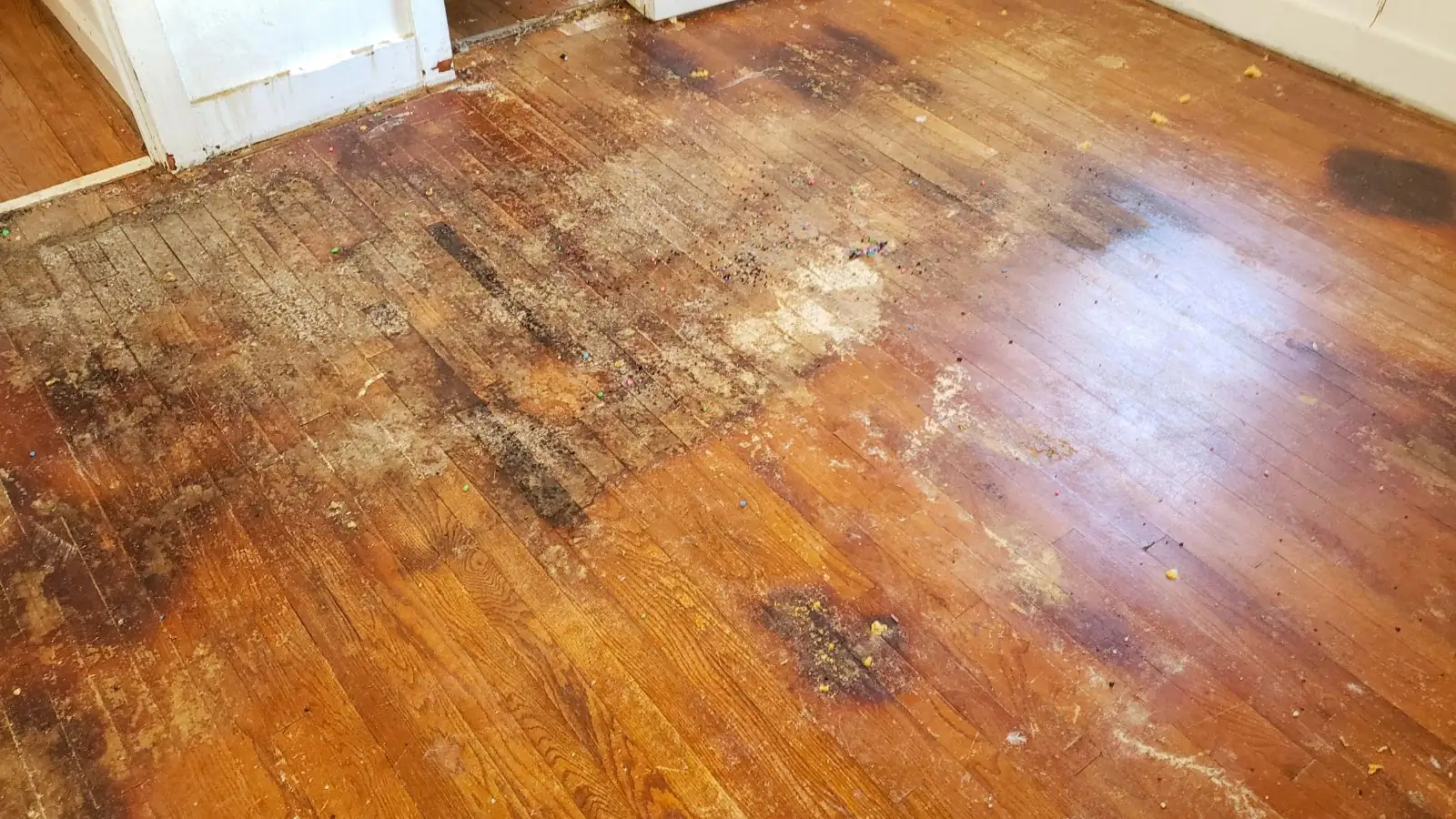
What water does to a wood floor
Wood takes up water through its grain and swells. Boards that are fixed at the edges push against each other, lift at the seams and cup, with the edges higher than the center.
Water that sits on a finished floor is bad enough, and water that gets underneath is worse because it cannot evaporate. The faster airflow reaches the underside, the better the odds of saving the boards.
What to look forStages of hardwood damage
Cupping
Board edges rise above the center after moisture reaches the underside.
Crowning
The center rises when the top dries faster than the bottom, often after sanding too soon.
Black or gray stains
Prolonged moisture or tannin reaction in the wood.
Buckling
Boards lift off the subfloor, a sign of heavy moisture.
Drying a hardwood floor
Extract surface water
We remove standing water and wipe the finish.
Read the boards
A moisture meter shows how deep the water went.
Dry with mats
Drying mats or panels pull moisture from the boards and subfloor.
Wait and reassess
We let the wood settle before sanding or refinishing decisions.
Refinish, repair or replace
| Condition | Usual path | Notes |
|---|---|---|
| Light cupping, caught early | Dry, wait, then sand and refinish | Wood may flatten as it dries. |
| A few stained boards | Replace those boards and blend | Match depends on the species and age. |
| Heavy cupping or buckling | Replace the section | Boards rarely return to flat. |
| Floor over a wet slab or crawl space | Fix the moisture source first | New floor will fail otherwise. |
Sanding too early traps moisture and can cause crowning. Let the floor dry fully, then decide.
Hardwood getting wet?
Call now. Floors dry best when drying starts within a day or two.
What affects hardwood repair costs
Area and species
Rare or wide-plank wood costs more to match.
Time wet
The longer it sat, the less recoverable.
Subfloor condition
A wet subfloor adds drying and repair.
Finish type
Site-finished and prefinished floors repair differently.
Refinishing scope
Sanding and finishing are billed by trade.
We explain scope and price before work starts.
Insurance basicsInsurance and wood floor damage
A covered water event, such as a pipe break or appliance leak, usually includes the flooring it damaged. Wear, humidity swings and long-term moisture are commonly excluded.
Take photos of the boards, note when you first saw the water and ask your carrier how it handles matching.
Local conditionsHardwood in Haverford Township homes
Many houses in Llanerch, Brookline and Beechwood date from the early 1900s, and houses of that era often have original oak or pine floors. Postwar homes in neighborhoods such as Manoa and Oakmont often have strip oak that was installed over wood subfloors.
Original floors can often be refinished more than once, which is why careful drying matters. For causes see appliance leaks and kitchen water damage, and for softer surfaces see carpet restoration. We also serve Ardmore.
ProcessHow hardwood dries
Drying mats pull moisture upward from the boards while sealed panels hold the air tight. A dehumidifier removes it from the room. The process takes days, and readings guide it.
Resist the urge to sand early, since wood that has not reached normal moisture content can shrink and leave gaps later.
Wood typesSpecies and finish matter
Oak, maple and pine take up water differently. Wide planks cup more than narrow strips, and site-finished floors repair differently from factory-finished planks.
If a section must be replaced, a matching species and a careful blend make the repair less obvious.
Other floorsEngineered and laminate floors
Engineered wood has a plywood core and a thin top layer, and laminate has a fiberboard core. Both swell at the edges when wet and rarely flatten again.
Quick drying can save a small area, but boards that have lifted at the seams are usually replaced.
Before the crew arrivesWhat to do in the first day with wet hardwood
Floor drying follows S500 procedures, and a moisture meter decides when boards are dry.
Quick steps limit cupping.
- Remove standing water and wipe the finish.
- Lift rugs and furniture off the floor.
- Do not sand or refinish until readings are normal.
Hardwood floor questions
Will my hardwood floor flatten after drying?
Light cupping often improves as the wood dries, but severe cupping or buckling usually does not recover.
Should I sand right away?
No. Sanding wet wood can trap moisture and cause crowning. Wait for readings to match dry wood.
Can a floor be saved after a flood?
Sometimes. Clean water caught within a day or two has the best odds, and contaminated water changes the answer.
How long does hardwood take to dry?
Days to weeks, depending on species, thickness and how wet it got.