
The honest answer
Most residential water damage jobs need equipment for several days. A small clean-water spill on a hard floor might dry in a day or two. A flooded finished basement with wet drywall and carpet pad can take a week or more.
Anyone who gives you an exact number before seeing the house is guessing. The readings decide.
What controls drying time
Several factors work together. How much water entered, how long it sat, what materials got wet, how warm and humid the air is and how much equipment is running all play a part.
Dense materials such as hardwood, plaster and masonry dry slowly. Carpet and thin drywall dry faster, especially if the pad or the lower section is removed.
Rough guideTypical ranges by material
These ranges are general. Your house may differ.
| Material | Typical drying | What slows it |
|---|---|---|
| Carpet with pad removed | 1 to 3 days | Humid air and thick pile. |
| Drywall wet at the base | 3 to 5 days | Insulation inside the wall. |
| Hardwood floors | A week or more | Species, finish and subfloor moisture. |
| Plaster and lath | Often a week or more | Thickness and old paint layers. |
| Concrete and masonry | Weeks to fully dry | Mass and low airflow. |
Equipment and setup
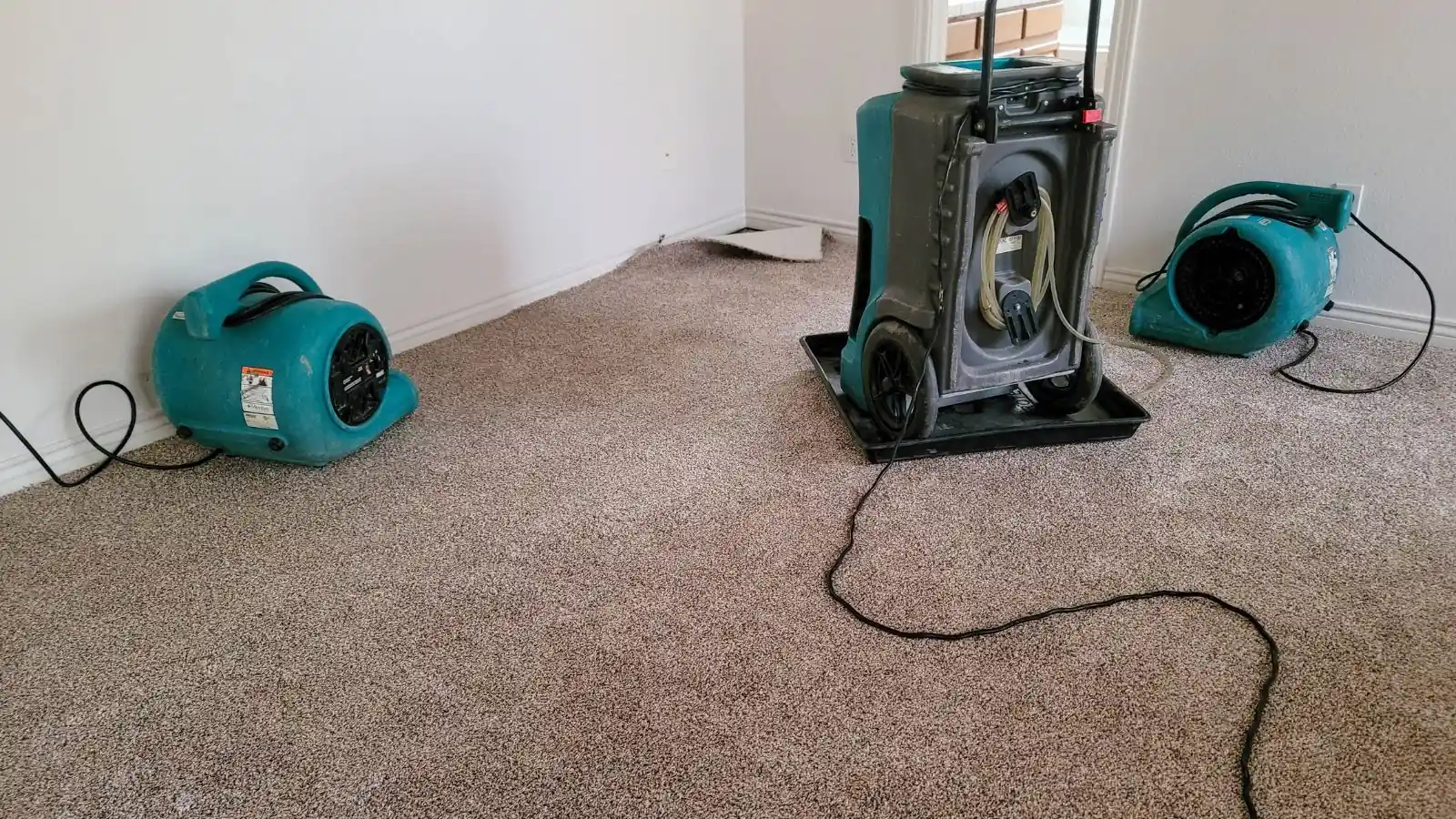
Air movers push air across surfaces, and dehumidifiers pull water from the air. A closed room dries faster than one with open doors and windows, since the dehumidifier works on a fixed volume of air.
Equipment placement matters. A crew moves it as areas dry, so effort goes where it is needed.
Still damp after days?
Call for readings and a drying plan.
Weather and season
Humid summer air slows evaporation and makes dehumidifiers work harder. Cold air holds less moisture, so basements in winter can need desiccant units.
Opening windows on a humid day can bring more moisture in. A crew will tell you when to keep them closed.
How to tell it is dry
Dry means the wet material reads close to a reference reading from an unaffected part of the same house. The log should show readings falling day by day.
If the numbers stop falling above the reference, something is still wet, and the crew should look for a hidden source.
What can delay drying
Closed cavities, insulation inside walls, wet subfloor, layered flooring and a source that is still leaking all slow things down. A crew may drill small holes, pull baseboards or lift flooring to reach trapped moisture.
Skipping that step leaves a house that looks dry and smells musty.
Drying wall cavities
Insulation and framing inside a wall dry slowly because air does not move there. Crews may drill small holes, remove baseboards or open a section of wall to push air in.
The openings are patched afterward, and they are far cheaper than replacing a wall that stays wet.
Drying floors from below
Water under flooring is the hardest to reach. Mats, panels or injection systems pull air through the layers, sometimes for days.
Ask the crew how they will confirm that the subfloor has reached normal readings before new flooring goes down.
When the schedule slips
If readings stall, the crew changes equipment, moves it or opens another area. Slow drying is not always a failure, since conditions change daily.
A clear log with notes on each change keeps everyone honest about what is happening.
Why a house can smell damp after it tests dry
Odors can linger in materials that were dry on the surface but wet inside. Clean the area, ventilate and recheck the readings.
If the smell stays, a hidden source such as a wall cavity or a crawl space may still be damp.
What to expect from the crew
Expect daily or every other day visits, a moisture log and equipment adjustments. Expect noise and some warmth from the dehumidifiers.
Ask when the crew expects to finish, and what readings will let them stop.
Next checkWhat to do if drying seems stuck
What to do is ask for the log, compare readings with a dry reference and look for hidden moisture. Procedures follow the S500 standard.
More detailWhat slows drying down
Thick materials such as hardwood, plaster and framing hold water longer than thin ones. Insulation and closed wall cavities trap moisture, which is why crews sometimes open a small section to let air in.
High humidity outdoors or in a closed house also slows the process, because air that is already damp absorbs less. Dehumidifiers matter more than fans in those conditions.
More detailWhat you can do to help
Keep doors and windows closed while dehumidifiers run, so the machines are not pulling in damp air. Keep the equipment plugged in and do not move it.
Move small items and furniture out of the wet area as the crew directs. Write down any new stain, smell or warm spot and tell the crew at the next visit. See structural drying for how the process is measured.
More detailHow the crew decides it is dry
The crew compares readings in wet materials with readings in dry reference materials of the same kind. Equipment comes out when the readings match, not when a set number of days has passed.
Ask to see the readings at each visit. A drying log with dates is also the record your insurer may ask for.
Haverford Township houses and drying
Haverford Township has warm, humid summers, and its older neighborhoods such as Llanerch, begun in 1897, and Brookline, begun in 1909, have masonry basements and plaster walls that dry slowly. Postwar neighborhoods such as Chatham Park often have finished basements with carpet and paneling.
The EPA advises drying wet materials within 24 to 48 hours to prevent mold, and the industry S500 standard describes the professional procedures for doing so.
What you can do while it dries
Keep doors to the wet room closed, leave equipment running and avoid turning it off to save noise. Open drawers and cabinets near wet areas, and keep the thermostat at a normal setting.
Ask the crew for the day's readings every visit. See structural drying and water extraction for the full process. We serve Ardmore and Wynnewood.
Common questionsDrying time questions
Will a plaster wall in a 1900s Haverford Township house take longer to dry than drywall?
Usually yes. Plaster and lath are thicker and hold moisture longer, so expect more days and careful readings.
Can I speed drying by turning up the heat?
A little warmth helps, but airflow and dehumidification matter more.
Is it normal for equipment to run all night?
Yes. Drying is continuous. A crew can position it to reduce noise.